
The Rise of the Chief AI Officer
Most companies are making the same mistake with artificial intelligence: they are treating it like software or as hype.
That instinct is understandable. For the last two decades, business leaders have been trained to evaluate new technology in familiar ways. A product emerges, vendors make their case, the IT department reviews security and compatibility, finance negotiates pricing, and another software subscription is added to the stack. That model worked reasonably well in the SaaS era.
It may prove inadequate in the AI era.
The companies that solve this early may create years of advantage.
Artificial intelligence is not simply another application layered onto existing workflows. It can replace certain repetitive tasks, dramatically accelerate others, and augment human expertise in ways that traditional software never could. It can also create new risks, new costs and new organizational confusion if deployed poorly.
That is why many companies may soon conclude they need a new executive role: the Chief AI Officer.
This is not a call for another fashionable title to populate the C-suite. It is a recognition that AI raises a distinct set of strategic questions that often sit awkwardly between the responsibilities of the CIO, CTO, COO and CEO.
Historically, chief information officers have been tasked with keeping systems reliable, secure and integrated. Chief technology officers have focused on engineering, product development and technical architecture. Chief operating officers have been responsible for execution and efficiency. CEO’s are looking for an AI Strategy. Each role remains vital. But AI introduces decisions that cut across all the domains.
The Chief AI Officer role would neither exist to champion AI for its own sake, nor to serve as a ceremonial symbol of innovation. It would exist to identify where intelligence creates value, where it destroys value, and where it should be constrained altogether.
The Problems
Who decides which functions inside a company should be reimagined with AI and which should remain entirely human? Who determines when a low-cost model is sufficient and when a premium model is worth the expense? Who owns the redesign of workflows rather than merely attaching AI to old ones? Who measures whether the promised productivity gains are real, sustained and economically rational?
At many companies today, the honest answer is: no one.
Instead, AI is spreading in a decentralized and often chaotic fashion, i.e. multiple models, multiple subscriptions and prompts everywhere. Marketing adopts one tool for content generation. Sales experiments with another for outreach. Customer service pilots chatbots. Operations runs quiet internal tests. Legal raises concerns about data handling. IT attempts to establish policy after the fact. Senior leadership asks why there has been so much activity and so little transformation. And none of this includes those employees using AI in secret.
This pattern is familiar in the early stages of any technological shift. But AI differs from prior waves because the technology is unusually flexible. It can touch nearly every department, every process and every knowledge workflow. Without clear ownership, experimentation can quickly become fragmentation.
An Example
Consider something as mundane as document processing. Many organizations confronting large volumes of contracts, claims, invoices or records will instinctively send everything to the most sophisticated model available. On paper, that feels prudent. Why not use the best intelligence money can buy? The reason is because much of the work may not require frontier intelligence at all. Don’t drive your Ferrari to the grocery store.
Initial steps such as extracting text, classifying document type, identifying dates or standardizing fields may be handled effectively by smaller internal models or lower-cost systems. The structured output can then be routed to more advanced models for nuanced reasoning, anomaly detection, negotiation support or strategic recommendations. The result may be similar, but the economics can be dramatically better.
That is not merely a technical optimization. It is a management decision about capital allocation, workflow design and competitive advantage.
The Role
[The Chief AI Officer role] would exist to identify where intelligence creates value, where it destroys value, and where it should be constrained altogether.
That executive would be expected to understand model capabilities and costs, but also incentives, process design, governance, compliance, change management and organizational behavior. The position would require enough technical fluency to engage engineers, enough operational credibility to work with line leaders, and enough strategic perspective to advise the CEO and board. It’s quite the renaissance position.
In time, some companies may distribute those responsibilities among existing executives. Others may fold them into the COO or CTO role. But many firms will likely discover that AI is too consequential and too cross-functional to remain an orphaned responsibility.
There is precedent for this kind of evolution. Companies did not always have chief information officers, chief marketing officers or chief data officers. Those roles emerged when new capabilities became central enough to merit executive ownership. Once technology reshapes the economics of an enterprise, governance structures tend to follow.
AI appears headed in that direction.
The winners in the next decade may not be the companies using the most AI. They may be the companies that manage it best: knowing when to automate, when to augment, when to spend heavily, when to use cheaper tools, and when human judgment should remain firmly in charge. The companies that solve this early may create years of advantage.
Those are leadership decisions. And leadership decisions usually end up with a title attached to them.
Chief AI Officer may sound premature today. But so do many titles—right before they become standard.
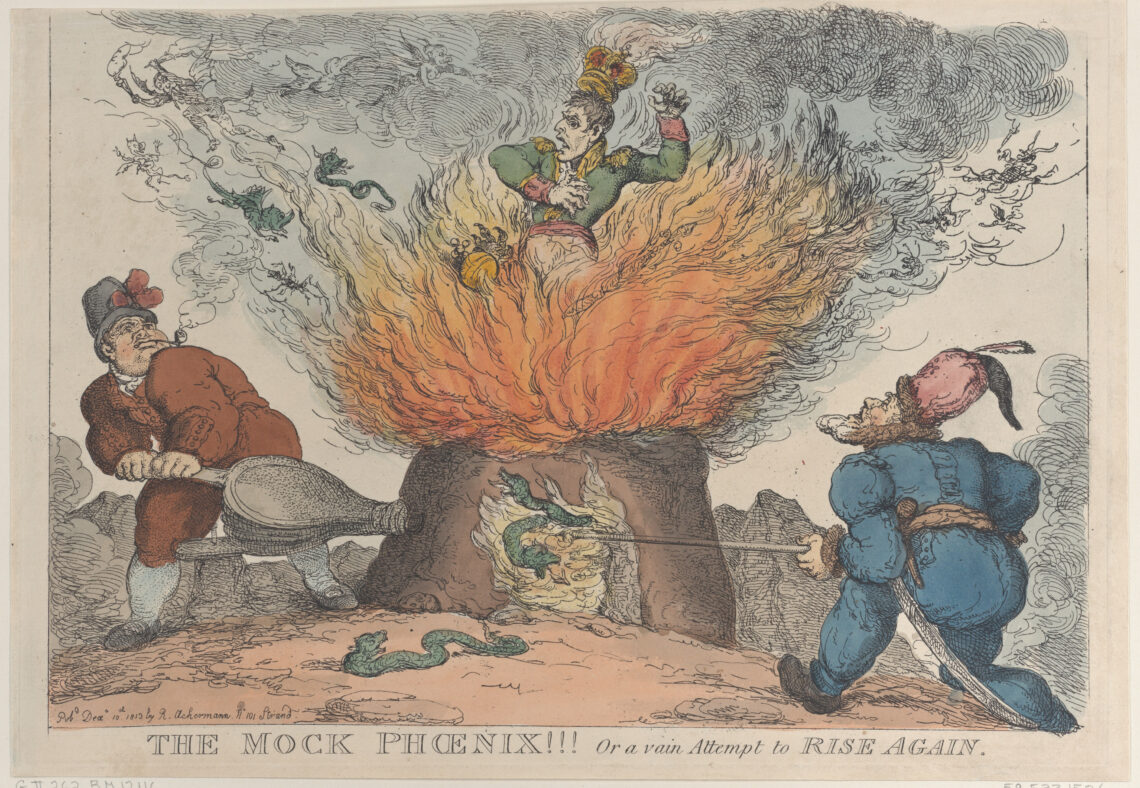
Art Sources:
Image Source: The Met Collection.
Artist: Thomas Rowlandson British
Publisher: Rudolph Ackermann, London British
Subject: Napoléon Bonaparte French
December 10, 1813


You May Also Like

“Did You Read It?”

Are We in an AI Bubble? No, but Still be Wary.